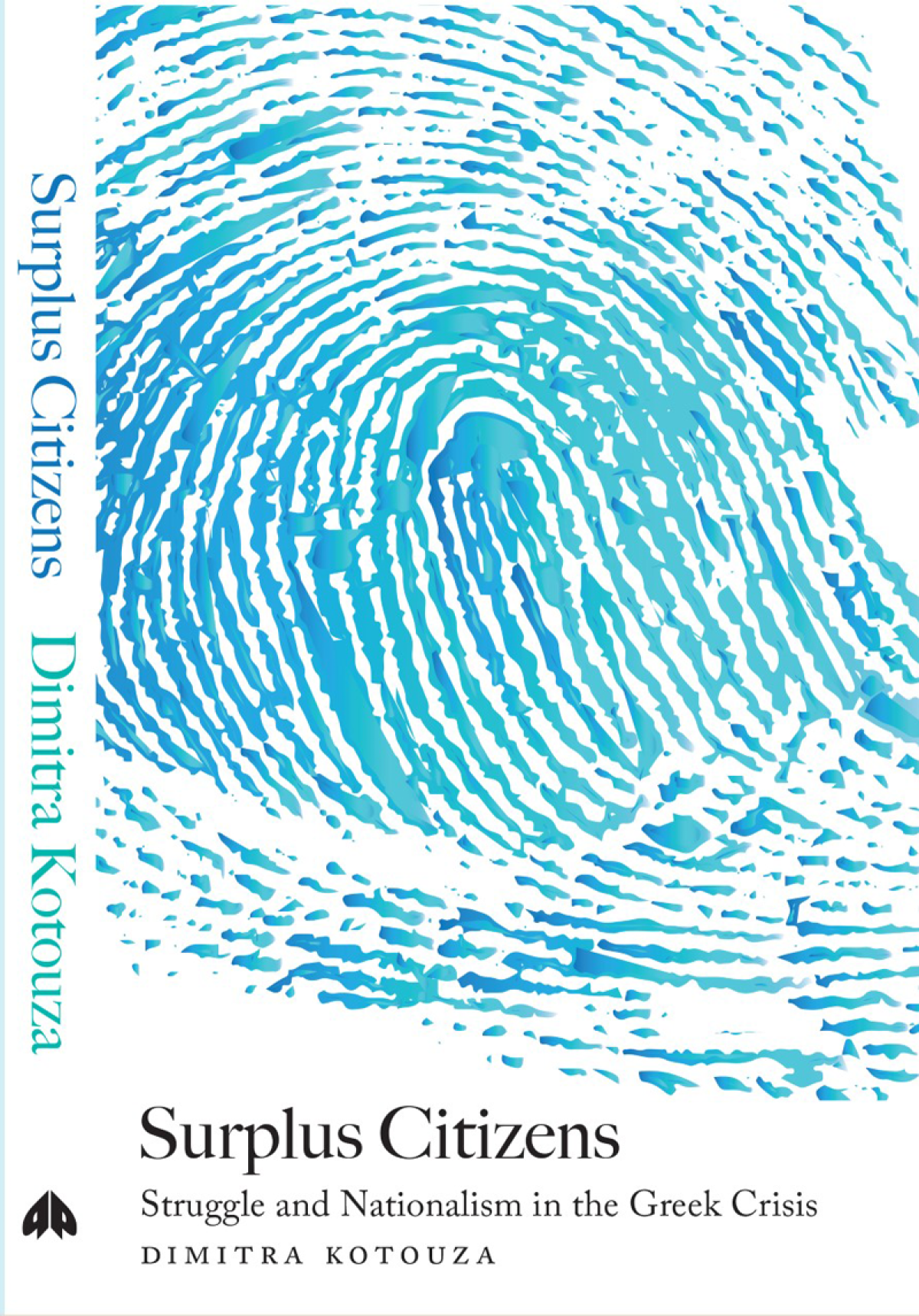
Surplus Citizens
Pluto Press
July 2019
304 pages
Paperback ISBN: 9780745337784
Back in October 2011, I began to trace the aftermath of the Movement of the Squares in Greece for the project that became Surplus Citizens. The project involved a politically-motivated ‘digging’ into the past and its supposedly established realities in order to give voice to what has been silenced, to throw into a different relief the social and personal anxieties associated with crisis, and to reinterpret popular scenarios for overcoming it, holding back from giving any easy answers.
I observed that the impulse to question the past, to re-narrativise authorised history, was present in every political and social space where the ‘Greek Crisis’ and what to do about it was being discussed. The stories offered by governments, whether those of Greece or its creditor states, had to be questioned, before it was possible to occupy Syntagma Square in Spring 2011. There, the questioning continued. But those revisions were multiple, troubling, opposed to one another, and while all of them provided their authors with a sense of emancipation, they certainly were not all emancipatory for everyone.
I was not a neutral observer documenting it all. My own agenda developed against what I called ‘the war discourse of the restructuring’: a proliferation, in a variety of fora, platforms and media—from the parliament and academia to national news media, to online blogs and social media—of historically revisionist discourses under the guise of ‘memory’ as a weapon in political conflict, which took archives of war as its material. This included, preferentially, the Second World War and the Civil War, but also the Greek War of Independence, the aftermath of the 1922 defeat in Asia Minor and the hanging of the ‘traitors’ that followed, as well as other historical moments of heightened political conflict, each time retold with a different inflection and highlighting a different episode depending on one’s side in the political struggle. After three decades of a mainstream political sphere dominated by what might be called a centrist common sense or political ‘apathy’, the polarisation between the left and right had returned explosively. Yet, the stakes of the clash were familiar and common to both sides. Each strove to prove that their political tradition had been the most loyal to the Greek nation and its people, while the other had betrayed them.
Meanwhile, the left-wing discourse on the crisis in Greece that reached the most prominent platforms of UK media, even when not engaged in this ideological war, still reflected the dominance of white male voices in the Greek radical left and anti-authoritarian milieux, leaving little space for other perspectives. Soon, the electoral victories of Brexit and Trump would even reawaken, among some Marxists, the condemnation of ‘identity politics’ for supposedly provoking a far-right backlash. In the book, I labour towards an analysis that takes Marx far beyond such conceptions of a class politics of unity. The politics of identity in movements is indeed problematic, but it is carried, in the first instance, by taken-for-granted socially and economically dominant identities claiming to represent the universal.
Given this ideological context, it seemed impossible to propose another view of the present without first tearing down the ‘icons’ of (right and left) nationalist rhetoric. Much of this work of disruption had already been done over the past three to four decades, challenging commonplace notions of what nation, race and their interrelation with class and gender has meant in the context of Greece. This formed the most crucial part of the book: the intellectual production and discourse in movements (the squares, assemblies, mutual support initiatives, labour actions, migrants’ mobilisations, environmental movements, anti-fascism) and radical collectivities across the left spectrum including anarchists, feminists, queer and antifa groups, sourced through public and individual discussions, political accounts and analyses, news blogs and magazines. They came into dialogue with critical scholarly work dispersed in a variety of Greek and Anglophone journals, books and self-published outlets that did not all speak to one another. Efi Avdela, Eleni Fournaraki, Effi Gazi, Penelope Papailias, Dina Vaiou, Athina Athanasiou, Stathis Gourgouris, Peter Bratsis were some of the academic authors whose work informed my incomplete ‘counter-archive’, alongside a North-Western critical literature that, inevitably, reflects its own geopolitical and cultural location. Their dialogue revealed the (often damaging) material consequences and emancipatory traces of attempts to resist intersecting forms of oppression/exploitation before and after the crisis. It signalled that ‘Greeks’—either as an idealised subject of struggle resisting austerity or as a scorned ‘people’ luxuriating in decadence and corruption—have never been a unified subject.
The range of historical, theoretical and contemporary ethnographic and documentary material collected for the book was used to ask the same question ad nauseam: who does the imaginary of each unity (Europe, the European citizen, Greece, the Greek citizen, the Greek ‘race’, Greek working and bourgeois classes, the Greek economy and industry, the ‘we’ of past and present social movements) oppress or leave out? What part of our material experience and identity does each attempt at unification force us to deny? For example, when and how did the labour movement in this region stop being multiethnic, stop being accused of Jewishness and ‘foreign infiltration’, and come to speak of itself as ‘Greek’? How has patriarchy been reproduced in the concept and practice of citizenship, as well as through the labour movement and the histories and imaginaries of the now ‘Greek’ left? And most important of all, when and how has this been challenged?
Back in the present, the book argued that the situation in Greece should also not be seen through the lens of a developmental Eurocentric philosophy of history, or through the oppositions between national production and international finance. Overcoming ‘crisis’ through ‘economic development’—‘creating jobs’ for superfluous, exploitable citizens—disregards the environmental and human costs of what has counted as ‘development', in both its capitalist or socialist guises. The movement against—and inter-communal strife over—the mine in Skouries amply demonstrates the lived contradictions around this issue, which have long replicated in mining regions worldwide. But the question is far from simply economic. It is invested with anxieties around race and ethnic identity, as well as gender. The embedding of racist (crypto-)colonial imaginaries in the historical construction of Greek national identity is linked to the desire for a culturally, racially and institutionally purified, truly ‘European’ Greece, free from supposedly ‘backward’ ‘oriental’ cultural elements (‘corruption’). Conversely, resistance to supranational hegemony, variously described as imperialist, German, European or Western, is often located in fetishised cultural elements (e.g. the supposed Greek insubordination towards laws and bosses) that mask existing relations of power. Discourses around the policing of and solidarity towards migrants from the Middle East and Africa crossing Greece’s borders are both inflected by these narratives, as are anxieties over securing the domestic, understood, explicitly or tacitly, as nation and as the familial, patriarchal household. This is a politics of anxiety, yearning for a kind of safety that endangers and silences those who do not fit in its hetero/cis-normative, patriarchal and racialised ideals. These and many more threads are drawn out in Surplus Citizens, alongside an attempt to re-theorise how power relations and identities fuel internal questioning within political movements whose aim is to universalise.
Publisher's Text
The crisis in Greece has elicited the full spectrum of responses – from optimism for a left parliamentary politics inspired by Syriza’s electoral victory, to pessimism about the intransigence of the EU and calls for the reinstatement of full national sovereignty in Europe.In Surplus Citizens, Dimitra Kotouza questions the terms of the debate by demonstrating how the national framing of social contestation posed obstacles to transformative collective action, but also how this framing has been challenged. Analysing the increasing superfluousness of subordinate classes in Greece as part of a global phenomenon with racialised and gendered dimensions, the book interrogates the strengths, contradictions and limits of collective action and identity in the crisis, from the movement of the squares and neighbourhood assemblies, to new forms of labour activism, environmental struggles, immigrant protests, anti-fascism and pro-refugee activism.
Arguing against the strategic fixation on unified identities and pointing instead to the transformative potential of internal dispute within movements, Surplus Citizens highlights the relevance of a discussion of Greece to collective action beyond it, as we continue to traverse a global financial crisis that has provoked conflicts over nationalism, immigration and the rise of neo-fascism.
Read the book's Introduction
Praise
‘Breaking the ethno-national and state-centred cage into which discussions of the Greek crisis have largely been confined,
Kotouza’s book puts questions of race, gender and migration at the core of its analysis and provides us with a powerful model for
investigating the dynamics and limits of contemporary surplus rebellions’
– Alberto Toscano, author of Late Fascism: Race, Capitalism and the Politics of Crisis
‘An extraordinary guide to our present’
– Joshua Clover, author of Riot. Strike. Riot: The New Era of Uprisings
‘In this original study, Kotouza powerfully shows how national social struggles, like the ones we witnessed in Greece in the aftermath of the
global financial crisis of 2008, are littered with contradictions and exclusions. Nevertheless by taking the politics of the excluded as its
horizon, Surplus Citizens offers us the hope of a more inclusive, transnational politics’
– Elena Loizidou, Professor of Law And Political Theory, Birkbeck University of London and author of Disobedience: Concept and Practice.
‘An extraordinary achievement. Kotouza’s incisive contribution to critical social theory and to the analysis of the contemporary dynamics of
capitalist social relations should be read by all’
– Werner Bonefeld, author of Critical Theory and the Critique of Political Economy: On Subversion and Negative Reason
Book Presentations
Book-Self: Surplus Citizens. Greek Studies Now: A Cultural Analysis Network. 2021.
Book presentation of Surplus Citizens. School of Philosophy, Politics and Economics, University of York, 22 November 2019.